

The Silent Years Are Speaking
A candid update on the manuscript’s progress, the challenge of writing Jesus’ unrecorded years, and what ordinary faithfulness is teaching me.
Round Enough, Hannah
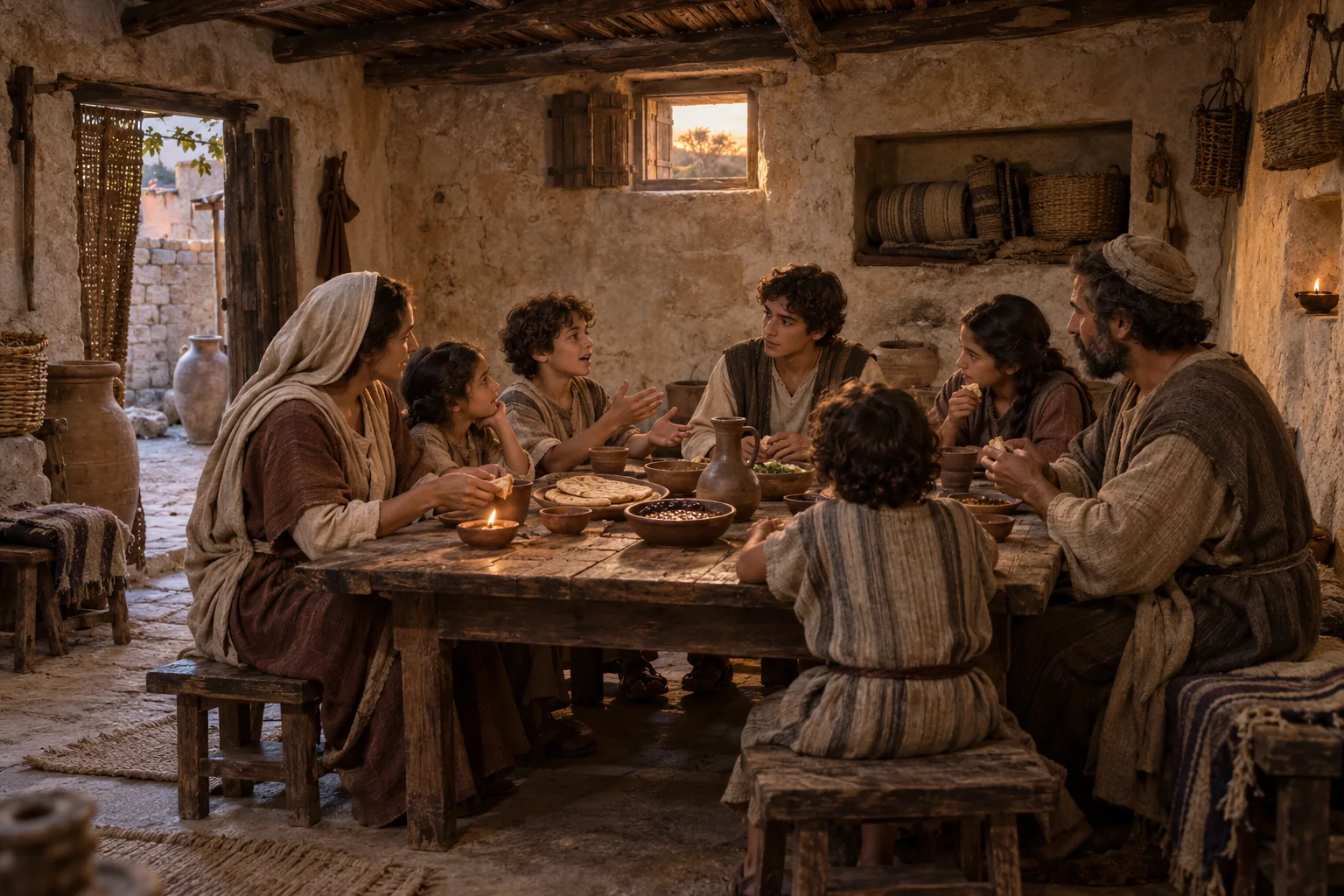
“That place is taken,” Hannah says.
Jesus stops with his hand on the bench. No one is sitting beside her.
“By whom?”
“You. Wash first.”
He goes to the basin. Behind him, Simon laughs, and Hannah tells him to move his elbow.
Jesus dries his hands and sits. Hannah has flour on her eyelashes. Before her lies a piece of dough with a bulge at one end and a narrow tail at the other. She pushes the bulge inward. The tail grows longer.
“It was round,” she says.
“What happened?”
“I made it better.”
Mary looks over from the hearth.
“Round enough, Hannah.”
“But this side.”
“It will still reach your mouth.”
Hannah brings her hands around the dough. “I can do it.”
“I know,” Mary says.
Hannah points to a split. Mary wets a fingertip, closes it, and lifts the dough with a small turn of her wrist. She leaves the long side alone.
“There. Yours.”
“It is for him.” Hannah nods toward Jesus without looking up.
He looks at the clean place she has kept beside her.
“Then may I have it?”
“When it is cooked.”
“Even that part?”
“Especially that part.”
Book Progressions
This week I reached one of those satisfying points where the manuscript begins to look less like a collection of scenes and more like a life unfolding.
The private reader manuscript now includes the prologue, Chapters 1 through 20, and the later chapters 28 through 33. Those later chapters carry Jesus toward the Jordan, John, and the threshold of the public life the Gospels record. The missing chapters between those sections are still important work. They cannot simply move the calendar forward. They must honestly carry the family, the relationships, and the choices that prepare Jesus to leave Nazareth.
That is one of the surprises of writing this book. I once thought the hardest part would be imagining what might have happened during the years Scripture does not describe. Instead, the hardest part is often deciding what must happen between two good scenes so the next moment feels earned.
I am trying not to hurry those bridges. A reader should feel that time has passed, that people have changed, and that choices have consequences. At the same time, every chapter must move the story. That balance is where much of my work is happening now.

Decisions & Dilemmas
The central dilemma remains the same: How do I write about the unrecorded years of Jesus without pretending imagination is history?
The Gospels tell us that Jesus grew in wisdom, stature, and favor with God and people. That short statement holds years of work, family life, worship, disappointment, laughter, temptation, responsibility, and ordinary days. The novel lives inside that space, but it must do so humbly.
I want the story to feel real enough that readers can smell the bread, hear tools against wood, feel the dust of the road, and understand why leaving home would cost Jesus something. Yet I never want a reader to confuse a scene I created with an event Scripture records.
That is why I keep returning to three questions: Does this fit the world of first-century Galilee? Does it honor what Scripture actually says? Does it help us see the humanity of Jesus without reducing his divinity?
Sometimes a beautiful scene has to be shortened. Sometimes an interesting idea has to be removed. Sometimes a quiet family conversation deserves more room than an event that looks dramatic on an outline. The goal is not to fit every good idea into the book. The goal is to tell one faithful, emotionally honest story.
What I’m Learning Spiritually
The silent years have begun to speak loudly to me.
Most of Jesus’ earthly life happened before the crowds, the miracles, and the public teaching. He lived years in which faithfulness probably looked ordinary to everyone watching. He worked. He listened. He learned. He loved his family. He faced temptation and disappointment one day at a time.
That encourages me because most of my own life is lived in days that will never look important to the world. I suspect the same is true for most of us.
We often wait for the moment when our purpose becomes obvious. We imagine that meaningful faith begins when something large happens. But perhaps God is doing some of his deepest work while we are repairing what is broken, keeping a promise, forgiving someone, caring for family, or choosing obedience when no one notices.
The hidden years were not wasted years. They were lived years.
That thought has changed how I see the book, but it is also changing how I see my own ordinary days. God does not have to make a moment public to make it sacred.


Inside the Author’s Head
I am encouraged, but I also feel the weight of getting this right.
The closer the story moves toward the Jordan, the more every earlier thread matters. A cup held in one chapter, a promise made beside a well, a grandfather’s remembered words, or a family wound that has not fully healed can return later with greater meaning. When that works, the story feels alive. When it does not, the reader can feel the author arranging pieces.
I do not want you to see me arranging pieces. I want you to know these people, care what happens to them, and feel the cost when Jesus finally turns toward the road ahead.
That means I am reading backward as often as I am writing forward. I am looking for promises that need to be kept, conversations that need an answer, and emotions that need time to breathe. It is slower work than I expected, but it is also deeply rewarding.
Thank you for following this journey while the book is still becoming what it needs to be. I value your thoughts, especially the questions or moments that stay with you. Please follow the work, and feel free to reply and tell me what you are thinking.
Until next time,
Russ